A 13-Year Journey to Publication in the Maryland Appellate Reports
By Christopher Dahl
Guest Contributor
Maryland appellate court-watchers are likely aware of the progress made in the Appellate Court of Maryland over the last decade to process appeals timely. In Fiscal Year 2014, the ACM adopted aggressive Case Time Standards to decide 90 percent of its appeals within nine months of argument or submission on brief, and 100 percent within one year of the same. In at least the last two fiscal years, the ACM has reported exceeding its nine-month metric by three to five percent, and the ACM has come within inches of meeting the one-year metric.
Recognizing this, many of those same court-watchers may have been surprised on July 28, 2025 when the ACM issued Deborah Lavine et al. v. American Airlines, Inc. While Lavine was, on the surface, a relatively uncomplicated appeal from the grant of a summary judgment to the defendant, it took a long time to get there, having been appealed more than 15 years earlier in the 2009 September Term of the then-Court of Special Appeals:
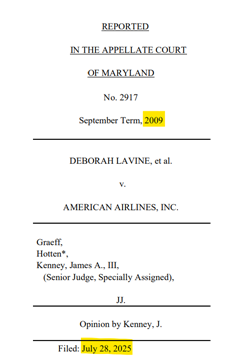
Given the ACM’s attention to case-decision time, how could this have happened? After some investigation, the reason turns out to be an almost uncanny synchronicity between the intended date of the opinion and the 2011 bankruptcy of American Airlines.
Lavine arose from a two-leg flight from Reagan National Airport to Key West, with a connecting flight in Miami, in December 2008. As recited in the factual background, when the plaintiffs arrived in Miami (on a substitute flight after the original flight was delayed), the airline told them that they had 15 minutes to get to the gate for the connecting flight. The plaintiffs made it in seven minutes, but the airline nonetheless denied them access to the connecting flight. Plaintiffs brought suit in the Circuit Court for Howard County, which granted summary judgment to American Airlines. Plaintiffs appealed to the then-Court of Special Appeals on February 22, 2010, and the case was argued before Judge Graeff, then-Judge (now Senior Justice) Hotten, and Senior Judge Kenney in June 2011.
On November 29, 2011, the Court of Special Appeals approved and designated as reported a 23-page opinion affirming the Circuit Court, which was filed with the Clerk of the Court and published on the Court’s website on December 1, 2011. Likely unknown to the Court at publication – and unknowable at the time of the decision to issue the reported case – American Airlines filed for Chapter 11 late in evening of November 29, 2011. See Case No. 1:11-BK-15464 (Bankr. S.D.N.Y. Nov. 29, 2011). As a result, the automatic stay voided the December 1, 2011 opinion, and the appeal was stayed. Although the opinion remained available on Westlaw in its pre-publication form (with West Headnotes) at Lavine et al. v. American Airlines, Inc., No. 2917, Sept. Term 2009, — A.3d —-, 2011 WL 13377948 (Md. Ct. Spec. App Dec. 1, 2011), the bankruptcy stay prevented the opinion from being properly issued. Thus, that December, the Lavine opinion settled in for what would become a nearly 14-year winter’s slumber.
A review of the circuit court’s docket on Maryland Judiciary Case Search suggests that, at some point, everyone simply forgot about the case, enough so that in 2024 the circuit court destroyed the case record according to the court’s retention schedule. None of that should be surprising. By then, the plaintiffs had effectively lost before two courts and, even were those decisions reversed on reconsideration or certiorari, the plaintiffs would be left with a likely discharged claim against a bankrupt corporation. But, in a remarkable showing of docket management, the ACM did not miss this loose thread. In June 2025, taking note that the American Airlines bankruptcy had long since ended, the Court lifted the stay sua sponte, rescinded the prior order, reconvened the original appellate panel, and, on July 28, 2025, issued the reported opinion that Senior Judge Kenney had authored nearly 14 years earlier.
The ACM is certainly not to be faulted on its case-decision metrics in this matter (and, to be clear, under the ACM’s Case Time Standards, a stay following a suggestion of bankruptcy does not count against those metrics). But, Lavine remains a curious example of how larger events impact case-decision time, and – futher to the intermediate appellate court’s progress in keeping those cases on track – how well the ACM now ensures that no case is forgotten.

 Maryland Appellate Blog