Fourth Circuit Arguments in Appeals from the District of Maryland, October 2025
Below is a list of appeals from the United States District Court for the District of Maryland being heard during the Fourth Circuit sitting that begins October 21, 2025. When available, we include the Clerk’s synopsis of the issues.
You can visit the Court’s argument calendar for more information on the appeals, including dates for each argument, PACER links to the briefs, and links for audio livestreams. On the morning of each argument day, the Clerk will update the argument calendar to disclose the composition of the three-judge panels.
To compile this list, we’re going only by the district judge’s name, which can be overinclusive (if a Maryland-based judge was sitting by designation elsewhere within the Circuit) or underinclusive (if an outside judge was sitting by designation in the District of Maryland). Feel free to leave a comment if we’ve missed anything.
Read More…September 2025 Maryland Certiorari Grants, Batch 2: The Smell of Retroactivity
This morning saw a surprise second batch of certiorari grants from the Supreme Court of Maryland. Both cases address the retroactivity of the 2023 statute that prohibits “law enforcement officer[s from] initiat[ing] a stop or a search of a person, a motor vehicle, or a vessel based solely on . . . the odor of burnt or unburnt cannabis.” Md. Code, Criminal Procedure § 1-211(a)(1).
In the second of the two cases, Judge Friedman authored a concurring opinion expressing his belief that Appellate Court’s reported opinions, giving the statute prospective-only operation, were wrongly decided. He also noted that other pending appeals raised the same issues.
Read More…September 2025 Maryland Certiorari Grants
On Friday, the Supreme Court of Maryland granted review in seven cases. The highest-profile case addresses whether the State may pursue an interlocutory appeal in the prosecution of Dr. James Strachan Houston, a retired Navy doctor accused of murdering his wife. And in Walston v. Lindsay, the Court will be addressing another jurisdictional puzzle over the scope of review in District Court appeals to circuit courts (following a puzzle last Term).
Read More…Timing is Everything: Palmer v. State, Reported Opinion by the ACM
On August 28, 2025, the Appellate Court of Maryland published Marconi Palmer, Jr. v. State (No. 1728, September Term, 2023, reported opinion by Beachley), addressing the sufficiency of the evidence in a DUI case. Specifically, the ACM held, as a matter of first impression, that a temporal connection is needed between a defendant’s last operation of a vehicle and his observed intoxication to support a conviction for driving under the influence or impaired by alcohol. Because there was insufficient evidence to prove that Palmer was under the influence at the time of the accident, the ACM reversed the convictions for DUI and DWI. The dissent (Judge Zic) disagrees with the majority’s reliance on the “temporal connection” which comes from out-of-state case law and would have affirmed the convictions because the circumstantial inferences were sufficient for a jury to find that Palmer drove under the influence of alcohol. Stay tuned, this case may go up.
Read More…Maryland’s Justices Trade Red Robes for Black
By Alec Sandler
Guest Contributor
Maryland court watchers may have noticed a change on Friday morning. After wearing their red robes on the first day of arguments for the September 2025 Term, the justices of the Supreme Court of Maryland traded their distinctive red robes for new black ones.
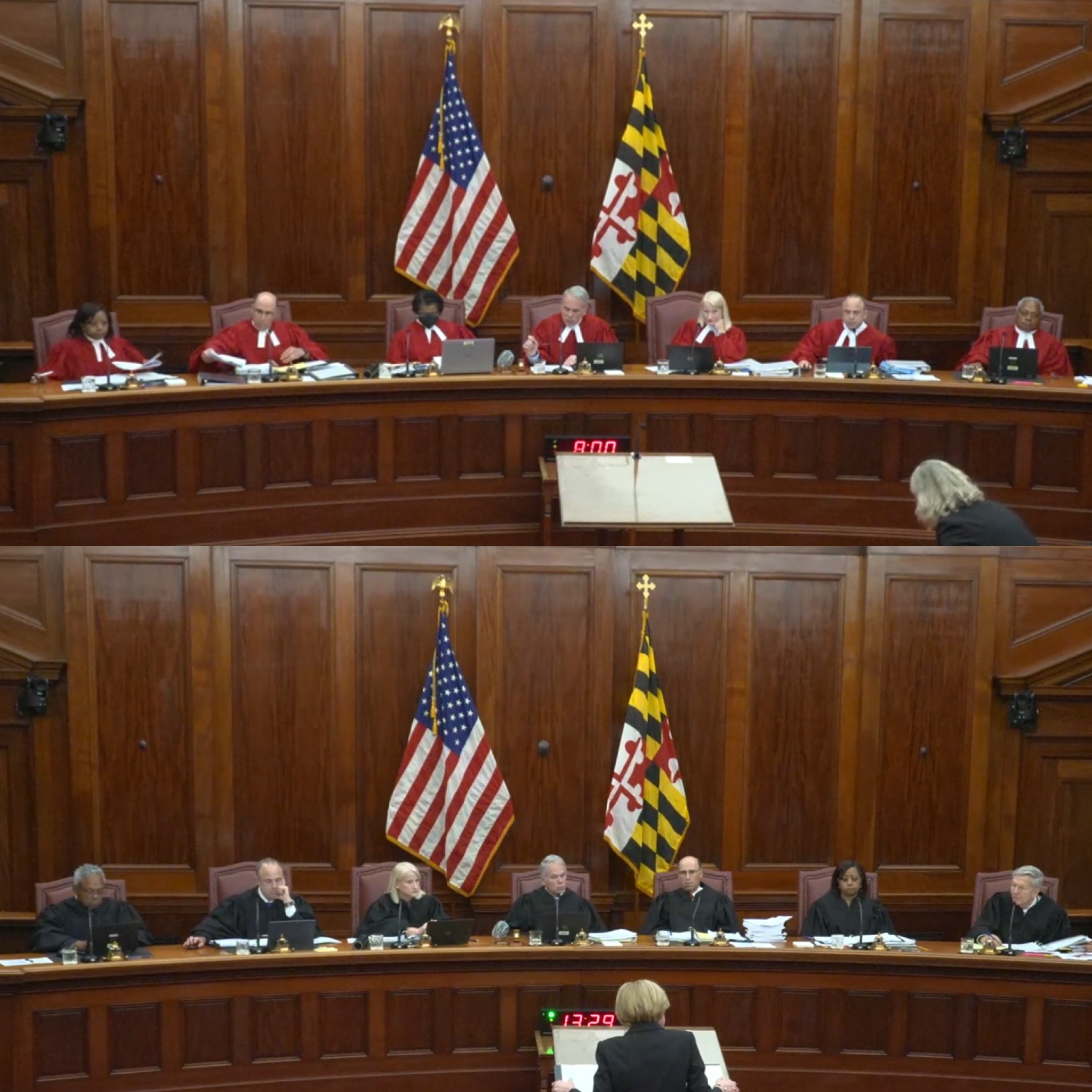
The Court has not made a public comment, but the “opening day” red robes suggest that the justices will continue to wear red robes on ceremonial occasions. Today’s black robes match the nation’s other 49 state supreme courts, whose justices all wear black.
[Update: The Court’s website now explains: “Beginning with the 2025 Term, the Supreme Court of Maryland will be wearing red robes for ceremonial occasions, including the first oral argument day of each term and for bar admissions ceremonies. The Court will return to wearing black robes on most other court days.”]
Read More…Fourth Circuit Arguments in Appeals from the District of Maryland, September 2025
As the blog turns twelve years old, we’re trying a new feature to expand coverage of federal appeals. The Fourth Circuit holds six weeklong argument sessions in Richmond each term. Below is a list of appeals from the United States District Court for the District of Maryland being heard during the Court’s sitting that begins September 9, 2025. Where available, we include the Clerk’s synopsis of the issues.
You can visit the Court’s argument calendar for more information on the appeals, including dates for each argument, PACER links to the briefs, and links for audio livestreams. On the morning of each argument day, the Clerk will update the argument calendar to disclose the composition of the three-judge panels.
Please note that, to compile this list, we’re going only by the district judge’s name, which can be overinclusive (if a Maryland-based judge was sitting by designation elsewhere within the Circuit) or underinclusive (if an outside judge was sitting by designation in the District of Maryland). Feel free to leave a comment if we’ve missed anything.
Read More…August 2025 Maryland Certiorari Grants
The Supreme Court of Maryland today granted review in two civil appeals and one criminal appeal.
Read More…A 13-Year Journey to Publication in the Maryland Appellate Reports
By Christopher Dahl
Guest Contributor
Maryland appellate court-watchers are likely aware of the progress made in the Appellate Court of Maryland over the last decade to process appeals timely. In Fiscal Year 2014, the ACM adopted aggressive Case Time Standards to decide 90 percent of its appeals within nine months of argument or submission on brief, and 100 percent within one year of the same. In at least the last two fiscal years, the ACM has reported exceeding its nine-month metric by three to five percent, and the ACM has come within inches of meeting the one-year metric.
Recognizing this, many of those same court-watchers may have been surprised on July 28, 2025 when the ACM issued Deborah Lavine et al. v. American Airlines, Inc. While Lavine was, on the surface, a relatively uncomplicated appeal from the grant of a summary judgment to the defendant, it took a long time to get there, having been appealed more than 15 years earlier in the 2009 September Term of the then-Court of Special Appeals:
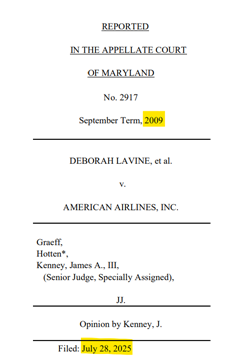
Given the ACM’s attention to case-decision time, how could this have happened? After some investigation, the reason turns out to be an almost uncanny synchronicity between the intended date of the opinion and the 2011 bankruptcy of American Airlines.
Read More…July 2025 Maryland Certiorari Grants
Today the Supreme Court of Maryland granted review in three civil appeals and one criminal appeal.
Read More…June 2025 Maryland Certiorari Grants
On Friday, the Supreme Court of Maryland granted review in two civil appeals and two criminal appeals. The headline case is Santana v. State, in which Judge Nazarian authored a concurrence suggesting the case was an appropriate vehicle for the Supreme Court of Maryland to reconsider the Double Jeopardy standard for when a defendant claims that the State’s recklessness forced a mistrial.
Friday also marked the first time, since Justice Michele Hotten retired from the Supreme Court of Maryland, that certiorari was granted to review an Appellate Court decision she authored.
Read More…
 Maryland Appellate Blog