A 13-Year Journey to Publication in the Maryland Appellate Reports
By Christopher Dahl
Guest Contributor
Maryland appellate court-watchers are likely aware of the progress made in the Appellate Court of Maryland over the last decade to process appeals timely. In Fiscal Year 2014, the ACM adopted aggressive Case Time Standards to decide 90 percent of its appeals within nine months of argument or submission on brief, and 100 percent within one year of the same. In at least the last two fiscal years, the ACM has reported exceeding its nine-month metric by three to five percent, and the ACM has come within inches of meeting the one-year metric.
Recognizing this, many of those same court-watchers may have been surprised on July 28, 2025 when the ACM issued Deborah Lavine et al. v. American Airlines, Inc. While Lavine was, on the surface, a relatively uncomplicated appeal from the grant of a summary judgment to the defendant, it took a long time to get there, having been appealed more than 15 years earlier in the 2009 September Term of the then-Court of Special Appeals:
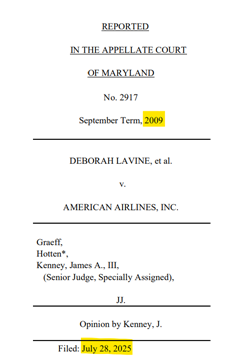
Given the ACM’s attention to case-decision time, how could this have happened? After some investigation, the reason turns out to be an almost uncanny synchronicity between the intended date of the opinion and the 2011 bankruptcy of American Airlines.
Read More…July 2025 Maryland Certiorari Grants
Today the Supreme Court of Maryland granted review in three civil appeals and one criminal appeal.
Read More…June 2025 Maryland Certiorari Grants
On Friday, the Supreme Court of Maryland granted review in two civil appeals and two criminal appeals. The headline case is Santana v. State, in which Judge Nazarian authored a concurrence suggesting the case was an appropriate vehicle for the Supreme Court of Maryland to reconsider the Double Jeopardy standard for when a defendant claims that the State’s recklessness forced a mistrial.
Friday also marked the first time, since Justice Michele Hotten retired from the Supreme Court of Maryland, that certiorari was granted to review an Appellate Court decision she authored.
Read More…A Theatre Kid’s Lessons for Appellate Practice
There’s a “theatre kid”-to-law-school pipeline.[*] Back in 2000, three out of four in my summer associate class, including me, were former theater majors. Although the parallels between theater and trials are more apparent, here are a few theater lessons that translate to appellate practice.
Read More…In Zimmerman v. State, the Supreme Court of Maryland Examines the Complex Jurisdictional Mechanics of Appellate Review of District Court Criminal Cases
By John Grimm
A recent decision by the Supreme Court of Maryland confirmed that when a circuit court exercising appellate jurisdiction over the District Court revokes a defendant’s probation, further review is available only in the Supreme Court by writ of certiorari. This holding, in Zimmerman v. State, Sept. Term 2024, No. 19,[1] is no surprise—it results from a very straightforward statutory reading—but the opinion by Justice Killough offers an interesting examination of the basic jurisdictional principles at play when the circuit court enters an order in its appellate capacity.
Circuit court appeals of District Court criminal matters are a procedural oddity (which you can read about in more detail in a post I wrote back in 2016[2]). Unlike the more familiar appellate model—where a court of appeals reviews a trial court decision on a fixed record—District Court appeals occur in the circuit court,[3] and, in criminal cases, take the form of a de novo trial.[4] These de novo trials look and operate exactly like any other trial in circuit court; if you observed one, you would never know that it was an “appeal” unless you were familiar with its procedural history. But a District Court appeal is still an appeal, which affects what kind of subsequent review is available. Ordinarily, the Appellate Court of Maryland has jurisdiction over final judgments of the circuit court.[5] But there is no right to Appellate Court review “from a final judgment of a [circuit] court entered or made in the exercise of appellate jurisdiction in reviewing the decision of the district court . . . .”[6] This leaves certiorari in the Maryland Supreme Court as the only option for review of a circuit court’s judgment in a District Court criminal appeal.[7]
Read More…Maryland Certiorari Statistics, 2024 Term
The judiciary’s annual statistical reports give the overall grant rate for civil and criminal certiorari petitions. But, because unrepresented (pro se) parties file the majority of petitions each year, the overall statistics are not terribly helpful for lawyers in advising their clients regarding the odds of certiorari.
Below are the statistics for the Court’s 2024 Term (petitions docketed 3/1/2024 to 2/29/2025), alongside the statistics for the 2023 Term (3/1/2023 to 2/29/2024) and 2022 Term (3/1/2022 to 2/28/2023) for comparison.
Read More…May 2025 Maryland Certiorari Grants
Today the Supreme Court of Maryland granted review in one civil appeal and two criminal appeals. In two of the opinions under review, Judge Harrell dissented from the Appellate Court’s opinion).
Read More…SCM adds one new case for this Term
The Supreme Court of Maryland today granted expedited bypass review in one case, adding it to the Court’s argument calendar for June 5, the last scheduled argument day for the September 2024 Term. A space opened up on the Court’s calendar upon the voluntary dismissal last week of In re Expungement Petition of Bradley B., which had been scheduled for argument on June 5.
Read More…April 2025 Maryland Certiorari Grants Include Climate Change Litigation
Yesterday, the Supreme Court of Maryland granted two civil petitions, including in climate change litigation. Both matters have been scheduled for argument in October.
Read More…Event: A Discussion About Daubert
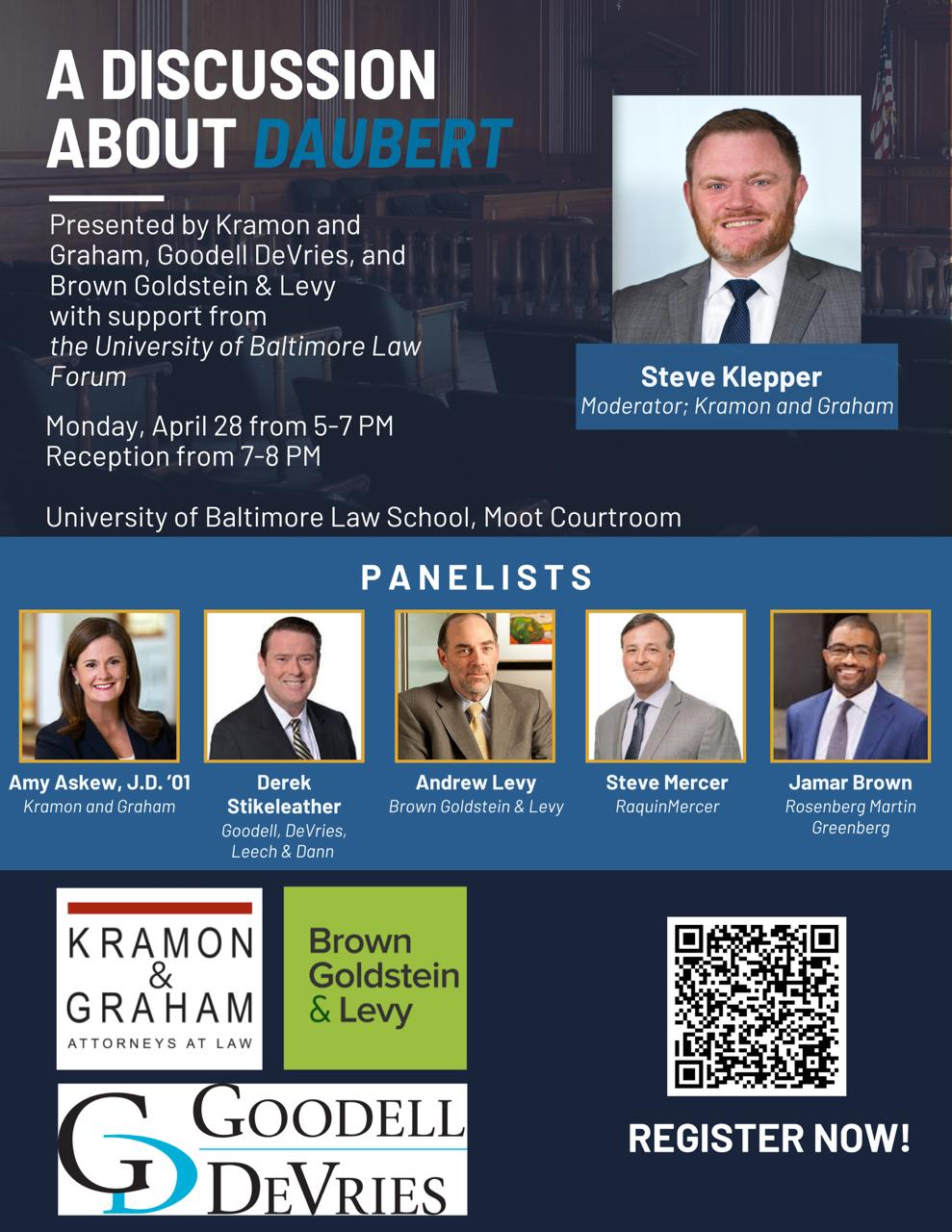
On Monday, April 28, at 5:00, the University of Baltimore Law Forum will host a panel discussion, sponsored by Kramon & Graham, P.A., Goodell DeVries, and Brown Goldstein & Levy, about the Daubert standard in Maryland.
Panelists include Derek Stikeleather, who has written prolifically on the topic; Amy Askew; Andy Levy; Steve Mercer; and Jamar Brown. Steve Klepper will moderate, with a brief presentation on his upcoming article, Appellate Review of Daubert Rulings.
A reception will follow. The link for free registration is here.

 Maryland Appellate Blog