Seven Maryland Justices, Seven Non-Maryland Law Schools
Pop quiz!
Question 1: Which court has more justices who received their law degrees from Maryland law schools?
(a) Supreme Court of Maryland
(b) Supreme Court of Montana
Question 2: Which of these courts has the fewest justices who received their undergraduate degrees from Maryland colleges or universities?
(a) Supreme Court of Maryland
(b) Supreme Court of Michigan
(c) Supreme Court of Montana
Maryland’s Justices Trade Red Robes for Black
By Alec Sandler
Guest Contributor
Maryland court watchers may have noticed a change on Friday morning. After wearing their red robes on the first day of arguments for the September 2025 Term, the justices of the Supreme Court of Maryland traded their distinctive red robes for new black ones.
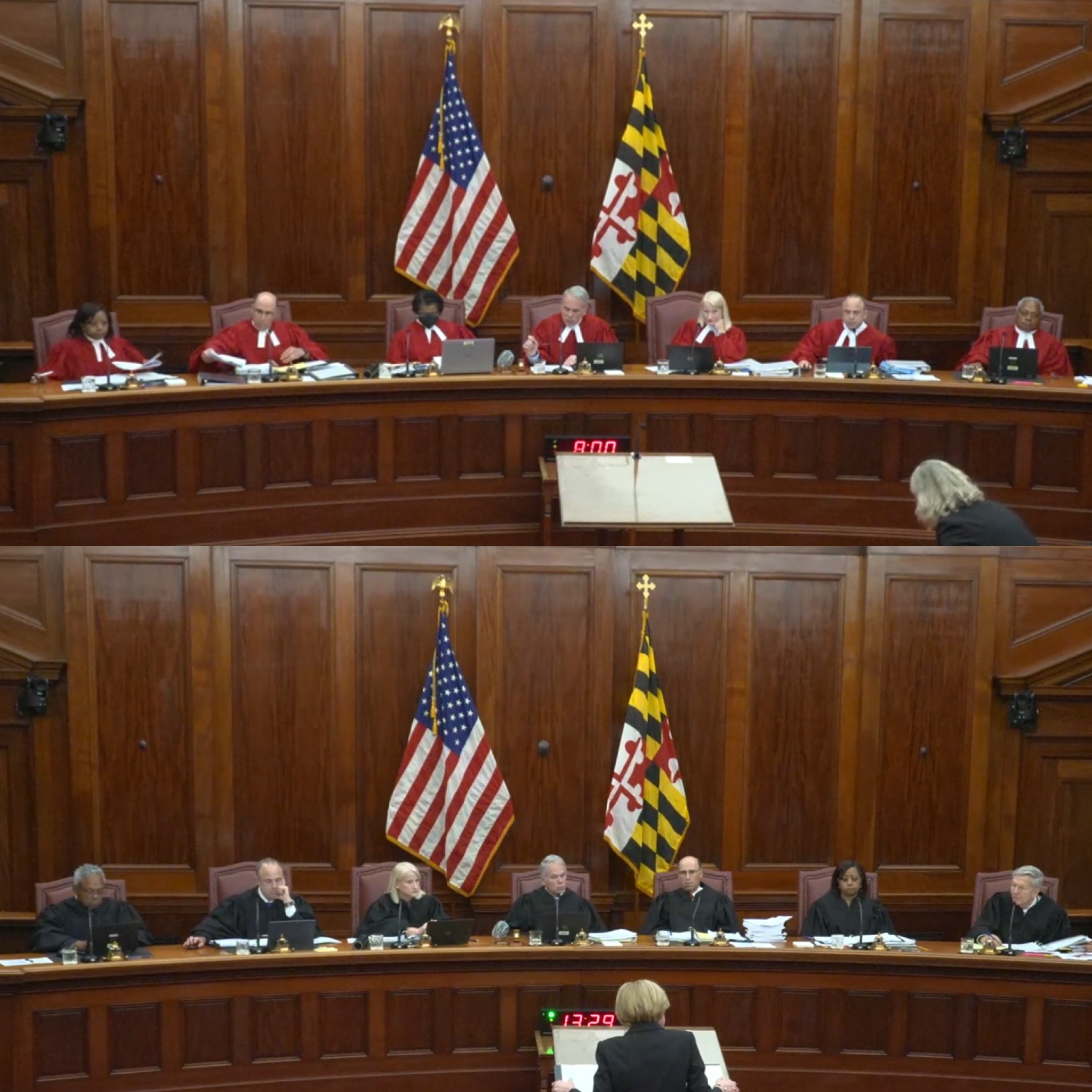
The Court has not made a public comment, but the “opening day” red robes suggest that the justices will continue to wear red robes on ceremonial occasions. Today’s black robes match the nation’s other 49 state supreme courts, whose justices all wear black.
[Update: The Court’s website now explains: “Beginning with the 2025 Term, the Supreme Court of Maryland will be wearing red robes for ceremonial occasions, including the first oral argument day of each term and for bar admissions ceremonies. The Court will return to wearing black robes on most other court days.”]
Read More…Vivian V. Simpson (1903 – 1987): From “a young woman not readily submissive to rules and regulations,”[1] to preeminent lawyer, bar president, and first female secretary of state for Maryland.
Early experiences with the judicial system are often formative and a catalyst for pursuing the practice of law and public service. In honor of Women’s History Month, this post will feature one such person – Vivian V. Simpson.
Read More…For Murphy’s Memorial, His Five Most-Cited Court of Appeals Cases
Tomorrow, the Supreme Court of Maryland will hold a special session to host a memorial service for one of its former members, the Hon. Joseph F. Murphy, Jr., who died in July of last year. There will be speeches by Erin Murphy and Richard Karceski, followed by a response by Justice Eaves — but no number of presenters can adequately convey just how many lives and careers Judge Murphy helped shape in the state’s legal profession. (I among them: Judge Murphy helped recruit me to my first job practicing law as an associate at Silverman Thompson Slutkin White, and he was always available to impart his wisdom on whatever tricky legal and appellate questions I encountered.) His widespread influence will long be felt.
Judge Murphy’s opinions endure across Maryland jurisprudence. In conjunction with today’s event, here are Judge Murphy’s five most-cited Court of Appeals cases — at least, according to an informal survey on LexisNexis — a brief sample of his expertise on evidence, adherence to procedure, and versatility in advancing the law in numerous practice areas.
Read More…Who was Maryland’s First Female Appellate Attorney?
In 2006 and upon the realization that “the State’s history of female lawyers was lost” on members of the Bar and the general public,[1] Judge Lynne A. Battaglia founded The Finding Justice Project, which resulted in extensive historical research and the publication of Finding Justice: A History of Women Lawyers in Maryland Since 1642 (“Finding Justice”).[2]
In the spirit of Finding Justice, I ask – Who was Maryland’s first female appellate attorney?[3]
Read More…The Institution of the Judiciary and Judicial Review, American Democracy’s Lifeline
Until recently, the social and political institutions of the United States long enjoyed, largely, the respect and the fealty of its citizenry. Though their raison d’etre vary, our institutions – our schools, houses of worship, courts, legislatures and more – all serve a common and fundamental function. They facilitate the conduct of orderly and rational discourse aimed at achieving consensus of purpose, in, importantly but not exclusively, matters of education, worship, governance, and commerce. Plainly, however, institutions do not guarantee discourse having such quality and effect. That depends, instead, on the character of each institution’s members. Given their essential function and the vital purposes, how is it that our most important institutions, those of government, have fallen so far in function and repute? Certainly bearing responsibility, at the federal and even state levels, has been the Supreme Court’s insensitivity to, if not abdication of, the unique position it occupies to protect our democratic form of government, which judicial proclivity is the subject of this post. We start first, though, with some political theory.
Read More…“This is the Way”— A Practical Roadmap Towards Constitutional Electoral College and Redistricting Reform.
By Michael Wein
Following last week’s election results, with Pennsylvania and Arizona decided and declared by all media outlets, President-Elect Joseph Biden and Vice President-Elect Kamala Harris’ will be Inaugurated on January 20, 2021. Considering the divisiveness of the 2020 election, it is unsurprising there has been significant online discussion of the present Electoral College system. This is also unsurprising, as two of the last six Presidential elections have gone to the candidate who did not win the popular vote nationwide. Two pending Federal Circuit Court of Appeals cases are strong Certiorari candidates to the Supreme Court, tackling Electoral College reform not through a transition to popular vote, but rather, a more accurate transition to the traditional Congressional District allocation method approved by Framers such as James Madison, and currently employed only in Maine and Nebraska.
Read More…Oral Arguments Postponed Left and Right Due to Coronavirus…At Least in Maryland, How Long Should this Last?
By: Michael Wein
It began with court and jury trials being postponed throughout the State of Maryland. But the past 10 business days have seen a remarkably swift progression in the postponement of appellate oral arguments in all Maryland and related Federal Courts due to the novel coronavirus. Read More…
Benisek v. Maryland Recap – The Forgotten Early 1900s Congressional Statute and How this Lafollette “Progressive Era” Reform, Supported Federal Judicial Interests against Political Party Gerrymandering
By Michael Wein
Last June in Ocean City, Maryland, the Supreme Court panel discussion for the Maryland State Bar Association (MSBA) convention, (which included guest panelists Kelsi Corkran, Prof. Shon Hopwood and Beth Brinkman) seemed to agree on one thing–the two pending political gerrymandering cases of Benisek v. Maryland and Gill v. Whitford, were likely to be the blockbuster decisions for the Court. That didn’t happen last year, with the Supreme Court not deciding the merits of those cases and remanding the Benisek case on procedural grounds.
Still, that left open the possibility the merits of the legal issue would come up again this year, and a decisive Majority opinion, particularly with the North Carolina Rucho case waiting in the wings. Unfortunately, for those who have studied the corrupting consequences on democracy and good government created by severe partisan redistricting, a year didn’t help. Instead, the clarity the Supreme Court decided, came in the form of a 5-4 opinion consolidating the Redistricting challenge of Benisek with that of North Carolina’s Rucho decision, concluding partisan gerrymandering will not be addressed by the Federal Courts as a “political question.”
As MdAppBlog contributor Alan Sternstein explained in a piece last week analyzing Rucho, excessive partisan gerrymandering, would appear to be quite justiciable, and logically makes sense, consistent with prior Supreme Court cases. Justice Elena Kagan’s Dissent, in favor of justiciability, discussed the little doubt, without Court intervention, the potential permanent possibility, of the lack of competitive Congressional elections, and an unnatural number of elected partisan Democrats and Republicans, as opposed to moderates, centrists, and independents. Chief Justice John Roberts’ Majority Opinion, perhaps ironically as a more optimistic perspective, in determining that the issue was non-justiciable in the federal courts, seemed to support alternatives, through Congressional action, or through the “state by state” approach of non-partisan redistricting Commissions. This piece focuses on the Congressional action alternative, particularly as related to the history of the Populist movement also known as the “Progressive Era” movement from the early 1900s. Part Two, when published will discuss the “state by state” approach alternative in more detail, both historically, and how that can be a guide for today.
A Necessary and Proper Post on the 200th Anniversary of McCulloch v. Maryland and the Upcoming Maryland Bicentennial Symposium
On March 6, 1819, exactly 200 years ago today, Chief Justice John Marshall issued his landmark McCulloch v. Maryland opinion, on behalf of a unanimous Supreme Court. On its face, McCulloch confirmed the federal power to create a national bank free from state taxation. But more enduring than the national bank’s charter (which expired by 1836) is the holding in favor of Congress’s implied powers, under the “Necessary and Proper” clause of the Constitution’s Article I, Section 8. Today, law students and elite legal minds alike continue to study the case and its lasting impact on our government framework and constitutional jurisprudence. Read More…

 Maryland Appellate Blog