Maryland Appellate Rules Amendments: Paper Copies and Images in Briefs
By Steve Klepper (Bluesky @mdappeal)
On Thursday, the Supreme Court of Maryland adopted a Rules Order (Feb. 19, 2026) containing several changes to Title 8 (Appellate Rules) and related provisions of Title 20 (electronic filing). These amendments “shall take effect and apply to all actions commenced on or after July 1, 2026 and, insofar as practicable, to all actions then pending.”
Below are the descriptions as they appeared in the Rules Committee’s 227th Report recommending these amendments. But first I will highlight the two most likely to have a practical impact on the average appeal.
First, in the Appellate Court, the number of paper copies of briefs and record extracts to be filed is reduced from eight to five, and the number to be served is reduced from two to one. The amended Rule 8-502 expressly allows parties to agree to waive service of paper copies on one another (as they often do already).
Second, the new Rule 8-503(d)(5) addresses a question that I have asked and been asked many times over the years: Do words in images count toward word limits? The new subsection (5) provides: “Images shall be used in a brief only for demonstrative purposes and not to avoid any word count limits.” For example, if your appeal involves a contract, you can’t evade word limits by pasting an image of the contract into the document. If there is something significant about visual cues in the contract, like indents or font sizes, the safe bet is to quote the language in the brief’s body (which counts toward the word limit) and then paste relevant parts of the image.
Read More…A 13-Year Journey to Publication in the Maryland Appellate Reports
By Christopher Dahl
Guest Contributor
Maryland appellate court-watchers are likely aware of the progress made in the Appellate Court of Maryland over the last decade to process appeals timely. In Fiscal Year 2014, the ACM adopted aggressive Case Time Standards to decide 90 percent of its appeals within nine months of argument or submission on brief, and 100 percent within one year of the same. In at least the last two fiscal years, the ACM has reported exceeding its nine-month metric by three to five percent, and the ACM has come within inches of meeting the one-year metric.
Recognizing this, many of those same court-watchers may have been surprised on July 28, 2025 when the ACM issued Deborah Lavine et al. v. American Airlines, Inc. While Lavine was, on the surface, a relatively uncomplicated appeal from the grant of a summary judgment to the defendant, it took a long time to get there, having been appealed more than 15 years earlier in the 2009 September Term of the then-Court of Special Appeals:
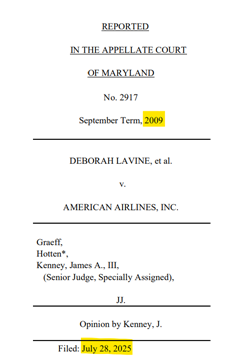
Given the ACM’s attention to case-decision time, how could this have happened? After some investigation, the reason turns out to be an almost uncanny synchronicity between the intended date of the opinion and the 2011 bankruptcy of American Airlines.
Read More…In Zimmerman v. State, the Supreme Court of Maryland Examines the Complex Jurisdictional Mechanics of Appellate Review of District Court Criminal Cases
By John Grimm
A recent decision by the Supreme Court of Maryland confirmed that when a circuit court exercising appellate jurisdiction over the District Court revokes a defendant’s probation, further review is available only in the Supreme Court by writ of certiorari. This holding, in Zimmerman v. State, Sept. Term 2024, No. 19,[1] is no surprise—it results from a very straightforward statutory reading—but the opinion by Justice Killough offers an interesting examination of the basic jurisdictional principles at play when the circuit court enters an order in its appellate capacity.
Circuit court appeals of District Court criminal matters are a procedural oddity (which you can read about in more detail in a post I wrote back in 2016[2]). Unlike the more familiar appellate model—where a court of appeals reviews a trial court decision on a fixed record—District Court appeals occur in the circuit court,[3] and, in criminal cases, take the form of a de novo trial.[4] These de novo trials look and operate exactly like any other trial in circuit court; if you observed one, you would never know that it was an “appeal” unless you were familiar with its procedural history. But a District Court appeal is still an appeal, which affects what kind of subsequent review is available. Ordinarily, the Appellate Court of Maryland has jurisdiction over final judgments of the circuit court.[5] But there is no right to Appellate Court review “from a final judgment of a [circuit] court entered or made in the exercise of appellate jurisdiction in reviewing the decision of the district court . . . .”[6] This leaves certiorari in the Maryland Supreme Court as the only option for review of a circuit court’s judgment in a District Court criminal appeal.[7]
Read More…Fourth Circuit announces three preferred fonts
Devoted followers of the Blog know this is the place for searing hot takes on developments in appellate typography. So of course we leapt into action upon Monday’s news that the Fourth Circuit has expressly approved three fonts (Times New Roman, Century Schoolbook, and Georgia) and expressly disapproved another (Garamond).
Granted, these choices are not exactly earth-shattering. Times New Roman, though always good fodder for typographical debate, remains ubiquitous and is not falling off any court-approved list anytime soon. Century Schoolbook is the most popular of the Century fonts, anointed by the U.S. Supreme Court as the chosen typeface family there. The third, Georgia—my go-to since Book Antiqua became inexplicably disfavored—has been steadily gaining acceptance as the most practical and versatile alternative to Times New Roman hegemony.
Read More…Pro Se Petitions and the Upcoming Coyle v. State Argument
By Steve Klepper (Bluesky @mdappeal)
Last week saw an unusual order from the Supreme Court of Maryland’s petition docket. In Feng v. Chen, the Court entered a GVR (grant, vacate, and remand) order on a pro se petition challenging the Appellate Court’s dismissal of an appeal when the appellant failed to order all circuit court transcripts.
Through the GVR order, the Court drew attention to a new program to aid pro se appellants:
Read More…SCM debuts SCOTUS-style orders list
By Steve Klepper (Bluesky @mdappeal)
We rarely cover certiorari denials, but today’s monthly list of denials featured a twist:

Clicking on the link brings you to an order with a familiar look for those who read the U.S. Supreme Court‘s certiorari orders:
Read More…Why Maryland Should Allow 28 Days for Post-Trial Motions
What attracts many lawyers to appellate practice—besides an unusual appetite for legal writing and a general distaste for contentious discovery—is the confidence that fire drills and surprises rarely occur. Appellate briefing deadlines and oral arguments are normally set months in advance, and extensions are liberally granted. Appellate lawyers often seem to be nicer (albeit nerdier) people. And everyone on appeal is bound by the trial-court record. No juries and no witnesses. Just the lawyers and a panel of judges applying the law to the settled facts on record.
This dynamic of unharried research and rules-driven deliberation often yields superior legal analysis, not because appellate lawyers are smarter than other litigators but because they usually have the time to reflect on an issue and get it right. They also know that opposing counsel and reviewing judges will have time to carefully consider whatever they write and say. Any missteps or misrepresentations will most likely be noticed and exposed.
Read More…Unreported Opinions Are Citable For First Time in Maryland on about 70% of Unreported Appellate Court of Maryland Decisions (and The World Did Not End)
By Michael Wein[*]
The Maryland Supreme Court approved a Rules Change (the specifics below), effective July 1, 2023, which for first time permits litigants to cite previous Appellate decisions for their “persuasive” value. These have generally been available online on the Maryland Judiciary’s website since May of 2015 and searchable since that time in the Maryland Daily Record, as well as Lexis and Westlaw. The proposed Rules presentation discussing this from February 2023 can be found on the Blog here.
Below is the final wording of Rule 1-104. (Without annotations)1
The Numbers in July, August, September, and October 2023 on Unreported Opinions Citable versus Per Curiam, Which Remain Uncitable
Beginning July 1, 2023, every unreported Opinion by the Appellate Court of Maryland (ACM) (formerly Maryland Court of Special Appeals), with the exception of per curiam decisions, states: “This is an unreported opinion. This opinion may not be cited as precedent within the rule of stare decisis. It may be cited for its persuasive value only if the citation conforms to Rule 1-104(a)(2)(B).”
Although the Maryland Supreme Court did not adopt all the recommendations of the Maryland Rules Committee, (again detailed below and a link to the zoom meeting here), there was a potential major exception to Rule 1-104 requested by the intermediate Appellate Court, and adopted by the Rules Committee, that still prohibits all citations to “Per Curiam” decisions. This was noted in the early blog piece, as a major potential loophole in the Rules proposal of it “Does not apply to Per Curiam Opinions in General (“Judge Per Curiam”).
Read More…Talking About Maryland’s Appellate Courts in the Past Tense
By Steve Klepper (Twitter: @MDAppeal)
Last month, Maryland voters approved a constitutional amendment renaming our appellate courts—with the Court of Appeals becoming the Supreme Court of Maryland, and the Court of Special Appeals becoming the Appellate Court of Maryland. Judges of the Supreme Court of Maryland will now be “Justices.”
Since then, lawyers have kept asking me the same question: “If I’m discussing a pre-name-change decision, do I use the new names and titles?”
Read More…Mark Your Calendars: Maryland Appellate Courts to Change Names on December 14
The Court of Appeals of Maryland posted this update today:
Read More…
 Maryland Appellate Blog