May 2025 Maryland Certiorari Grants
Today the Supreme Court of Maryland granted review in one civil appeal and two criminal appeals. In two of the opinions under review, Judge Harrell dissented from the Appellate Court’s opinion).
Read More…SCM adds one new case for this Term
The Supreme Court of Maryland today granted expedited bypass review in one case, adding it to the Court’s argument calendar for June 5, the last scheduled argument day for the September 2024 Term. A space opened up on the Court’s calendar upon the voluntary dismissal last week of In re Expungement Petition of Bradley B., which had been scheduled for argument on June 5.
Read More…April 2025 Maryland Certiorari Grants Include Climate Change Litigation
Yesterday, the Supreme Court of Maryland granted two civil petitions, including in climate change litigation. Both matters have been scheduled for argument in October.
Read More…Event: A Discussion About Daubert
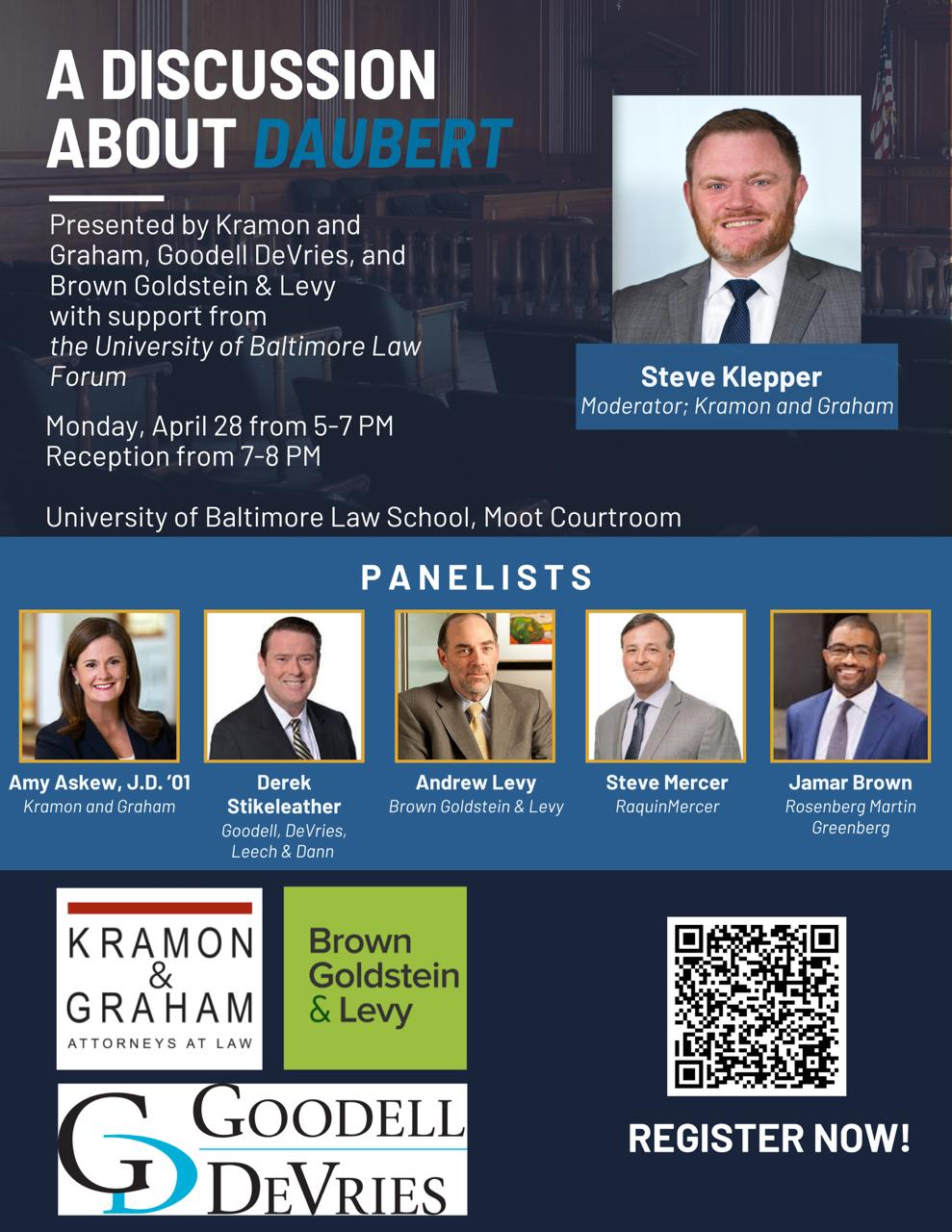
On Monday, April 28, at 5:00, the University of Baltimore Law Forum will host a panel discussion, sponsored by Kramon & Graham, P.A., Goodell DeVries, and Brown Goldstein & Levy, about the Daubert standard in Maryland.
Panelists include Derek Stikeleather, who has written prolifically on the topic; Amy Askew; Andy Levy; Steve Mercer; and Jamar Brown. Steve Klepper will moderate, with a brief presentation on his upcoming article, Appellate Review of Daubert Rulings.
A reception will follow. The link for free registration is here.
Appellate Court Undermines Rochkind by Conflating Rule 5-702 and Rule 2-501
[DISCLOSURE: Although I do not represent the defendant hospital in Jabbi v. Adventist Healthcare, Inc. No. 2071 (Sept. Term, 2023) (March 5, 2025) (reported), I often represent Maryland hospitals seeking to exclude causation experts favored by the Plaintiffs’ Bar. That said, I have devoted more of my professional life to the admissibility of causation-expert testimony under Rule 5-702 and the impact of Maryland’s adoption of the Daubert standard in 2020 than to any other subject. The Appellate Court’s reported Jabbi opinion merits not only commentary but also certiorari.]
Maryland cannot simultaneously adopt Daubert, as the Supreme Court of Maryland expressly did in its 2020 Rochkind v. Stevenson decision, but subsequently reject General Electric Co. v. Joiner’s bright-lineabuse-of-discretion standard—as the Appellate Court apparently did in the recent reported decision Jabbi v. Adventist Healthcare, Inc., No. 2071 (Sept. Term, 2023) (March 5, 2025) (reported).Because the defendant would have been entitled to summary judgment if the expert was excluded, the Jabbi court viewed the challenged expert testimony in the “light most favorable” to the expert. Allowing Jabbi to stand as a precedential opinion would destroy the clarity that adopting Daubert provided and open a second era of “jurisprudential drift” for Maryland’s expert-testimony case law.
Read More…March 2025 Maryland Certiorari Grants
The Supreme Court of Maryland on Friday granted review in five different appeals. The grant in the sealed In re: Criminal Investigation matter is on four different petitions. The questions differ slightly among the four petitions; we have listed the questions presented on No. 7, which is the most comprehensive.
Read More…February 2025 Maryland Certiorari Grants
Last Friday, the Supreme Court of Maryland granted review in two civil cases. It has assigned both cases for argument during the 2025 Term, which begins in September.
Read More…When Is an Appellate Rule Not a Rule?
Attorneys love rules. And our adversarial legal system functions best when both sides understand and follow common rules. So one Maryland appellate rule has always confounded me because it is routinely construed as meaning the opposite of what it apparently says. Rule 8-501(c) plainly states that the “record extract shall not include . . . any part of a memorandum of law in the trial court, unless it has independent relevance.” Most lawyers would reasonably construe this as telling practitioners to exclude their trial-court briefing from the record extract unless the brief itself had factual relevance—e.g., including a brief to show that an argument was not waived or that a party made inconsistent arguments.
But this is not how the Rule is read in Maryland. Former Maryland appellate clerks and even some Maryland appellate judges have repeatedly told me that if, for example, a party prevails on summary judgment or a motion to dismiss, the court and its clerks appreciate having the related briefing in the record extract. The Rule would indicate that the record extract should contain the exhibits to the relevant briefing without the briefs themselves. Apparently not.
Read More…Panel Splits on Stops for “Security Checks”
By: Chris Mincher
Police officers on the lookout for crime know that people with illegal things usually try to conceal them. If the object is big and bulky enough, sometimes that isn’t so easy. People who carry illicit items under their clothes might have to take some extra measures to make sure they stay there.
On the other hand, while concealing a firearm is typically a crime, generally shoving things into one’s pants is not. As such, Maryland courts have decided that mere adjustments and manipulations of the waistline don’t create a reasonable suspicion of illegal activity without some other indication that a gun is involved. But what if the police officer describes those adjustments and manipulations as specific “security checks” consistent with a potential concealed firearm? Does that pass muster for Fourth Amendment purposes?
Read More…January 2025 Maryland Certiorari Grants
Yesterday, the Supreme Court of Maryland granted review in five cases. (We’ve updated this post now that “Questions Presented” are publicly available for all five cases.)
Read More…
 Maryland Appellate Blog