Seventeen Days to Go and Two Potential Blockbuster Maryland Court of Appeals Cases Left to Decide!
By Michael Wein
It’s time for the Annual* “Blockbuster” Court of Appeals decision watch. Three years ago, with about one week to go before the Maryland Court of Appeals’ self-imposed deadline of August 31st for deciding all cases in the term, the Court had only four cases left to decide. Two years ago, with two weeks before the Court’s deadline, there were 11 decisions left undecided. With a little more than two weeks to go before this year’s deadline, nine (9) decisions remain undecided, per the “Pending Cases” page on the Court of Appeals’ web site, with four (4) of those cases related to the topic of juvenile life sentences (that will likely involve some form of consolidated opinion, or opinions that will cross-reference each other). Of these 9 cases, one is civil, five are criminal, and three involve an Attorney Grievance matter. A listing of these cases’ Questions Presented from the Court of Appeals’ website, can be found at the bottom of this post.
August 2018 Maryland Certiorari Grants
By Steve Klepper (Twitter: @MDAppeal)
On Friday, the Court of Appeals of Maryland granted certiorari in three criminal cases and one civil case. All three criminal grants were on petitions by the State.
One that jumps out is In re G.R., where the State challenges an unreported Court of Special Appeals opinion that struck $65 from a restitution award in a juvenile case. Read More…
Thank You for Writing Dissents
By Steve Klepper (Twitter: @MDAppeal)
At this year’s bar convention, I took the opportunity to thank Senior Judge Irma Raker for something she did 12 years ago. When I lost the first Court of Appeals case that I argued, Judge Raker wrote a short solo dissent. It meant a lot to me as a young associate, having entered argument feeling like I would win, to know I’d convinced at least one judge.
There are a many different reasons why appellate judges write dissents or refrain from writing them. From a private practitioner’s standpoint, I tell judges that dissents are a powerful way to improve attorney-client relationships. Read More…
July 2018 Maryland Certiorari Grants Include State v. Adnan Syed
The Court of Appeals today posted six certiorari grants, including in the high-profile State v. Adnan Syed appeal. The grants, with questions presented and links to the Court of Special Appeals decisions under review, follow the jump. Read More…
Hillary Clinton’s e-mails, attorney discipline, and the original and exclusive jurisdiction of the Court of Appeals – Attorney Grievance Commission v. Clevenger
Hillary Clinton’s use of a private e-mail server to conduct business as Secretary of State has been the primary focus, or at least an aspect, of various investigations, including ones by the FBI, the State Department’s Office of the Inspector General, the House Select Committee on Benghazi, and the House Oversight Committee. Add the Maryland Attorney Grievance Commission, Bar Counsel, and Court of Appeals to the list of authorities who have now touched some aspect of that controversy. After a Texas lawyer persuaded a circuit court judge to order the Commission and Bar Counsel to investigate three lawyers for actions they allegedly took while representing Clinton, the Court of Appeals held that the circuit court lacked jurisdiction over the Texas lawyer’s request.
Free Speech May Have Some Limits
One of the fundamental tenets of the United States Constitution is the freedom of speech, which includes the ability to air our grievances about government activities. Fane Lozman did just that in the City of Riviera Beach, Florida. During the public participation portion of a meeting held by the City Council, Mr. Lozman began to discuss the recent arrest of a former county official. After several requests to cease his remarks, the Council asked for the assistance of a police officer. When Mr. Lozman continued to refuse to cooperate, he was arrested for disorderly conduct and resisting arrest. Although later released, the posture of the case as it reached the Court required analysis of the principles related to lawful arrests in the context of the First Amendment prohibition against government retaliation when a person exercises his right to free speech. The decision issued by the Court in June in Lozman v. City of Riviera Beach, Florida, 585 U.S. ___ (2018), focused less on the public forum aspects of the case than on the probable cause for arrest and the possible retaliation of the Council.
What an 18-Year Term Limit for Supreme Court Justices Might Look Like
By Steve Klepper (Twitter: @MDAppeal)
By a large majority, Americans favor term limits for Supreme Court justices. As Professor Orin Kerr has observed on Twitter: “Reminder: It is incredibly weird that how many Supreme Court picks a President gets depends on who decides to retire or who dies. 18-year terms would make so much more sense than life tenure. Every Prez would get two picks.” I agree with this idea. The devil, however, is in the details.
A constitutional amendment is necessary, and the mere perception of partisan advantage is likely to prevent ratification by the necessary 38 out of 50 states. A delayed effective date could help, even if it may not be enough for an amendment to get traction.
Still, I think it is worth at least starting a conversation on what a term-limits amendment might look like. Read More…
Why Maryland Appellate Courts Should Send Focus Letters Before Oral Arguments
Appellate practitioners continuously debate the relative value of oral argument. Although most practitioners—and many appellate judges—agree that the quality of appellate briefing matters much more than the quality of oral advocacy, opinions vary considerably on how much oral argument helps. Some contend that oral argument is more trouble than it is worth. Others disagree, believing that oral argument not only often separates winning and losing on appeal but also increases everyone’s faith in the justice system. Both sides of the debate have some good points; I won’t try to declare a winner here.
One fact beyond debate is that federal appellate courts are holding significantly fewer oral arguments. Read More…
Maryland Certiorari Statistics, September Term 2017
By Steve Klepper (Twitter: @MDAppeal)
I’m often asked what percentage of certiorari petitions the Maryland Court of Appeals grants. Each year, the Maryland Judiciary publishes a statistical abstract. The most recent report includes this table:
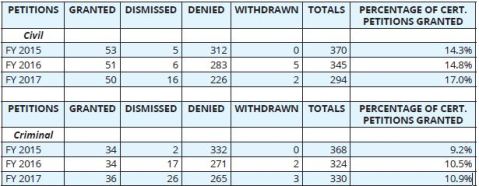
I’ve begun reviewing the Court’s petition docket to get more details. Read More…
COSA Spotlight: Judge Andrea Leahy
By Steve Klepper and Diane Feuerherd
Continuing our series profiling members of the Court of Special Appeals, we interviewed Judge Andrea Leahy, one of the eight At-Large Judges of our intermediate appellate court, in her chambers on Rowe Boulevard in Annapolis.

 Maryland Appellate Blog