Who’s the appellant, what’s the appellee, and I don’t know if we have jurisdiction.
The Court of Special Appeals recently issued an opinion that calls to mind the famous Abbott and Costello comedy routine, “Who’s on First.” Read More…
Sketches of a Fourth Circuit Argument
By Steve Klepper (Twitter: @MDAppeal)
Supreme Court sketch artist Art Lien recently posted some amazing sketches from the October 30, 2013 Fourth Circuit argument in United States v. Dehlinger, No. 12-7121. As luck would have it, two of the panelists (Judges Diana Motz in the center and Andre Davis on the right) are Maryland-based. The third is Judge Roger Gregory of Virginia. With Mr. Lien’s permission, I’ve re-posted two of the sketches below. The first provides a wonderfully detailed view of the Fourth Circuit’s Red Courtroom (Room 412). The second depicts the grand tradition of the Fourth Circuit shaking hands with counsel after each argument.

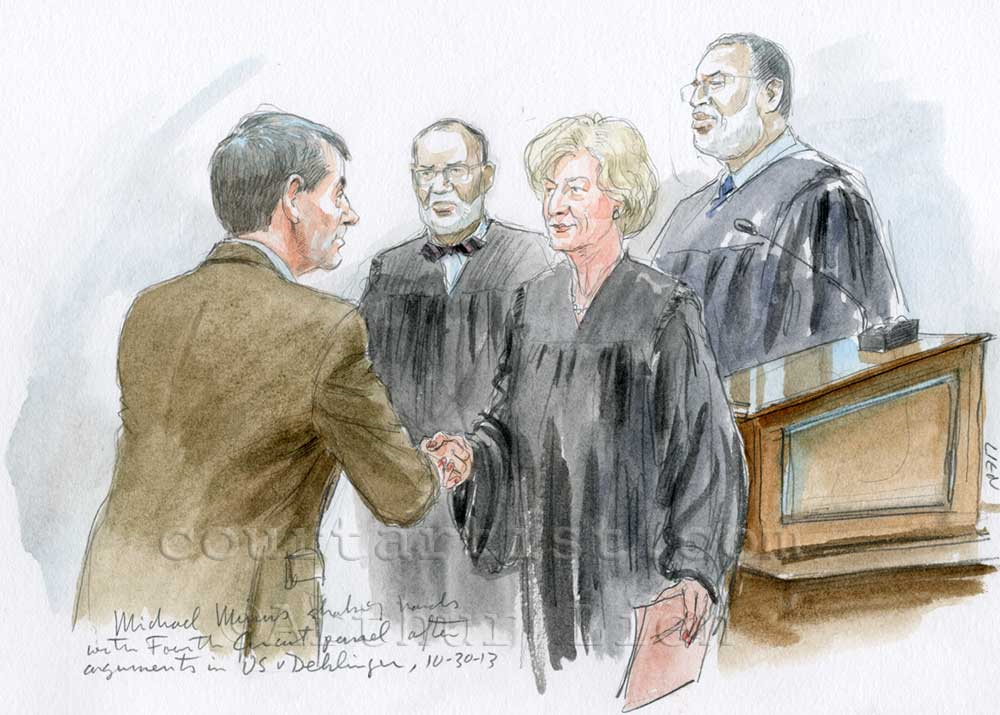
I’m particularly fond of the handshake tradition. In an appeal that I took over in 2010 as a result of the illness and untimely death of one of my firm’s partners, the dearly missed Max Lauten, Judge Davis, who sat on the panel, made a special point of conveying his condolences. Judge Davis did write the opinion against my client, but I do genuinely appreciate the thoughtfulness of his published opinion.
According to the Fourth Circuit’s argument calendar, the issue in Dehlinger was whether the “district court correctly denied relief on ineffective assistance of counsel claim that alleged counsel’s representation was tainted by conflict of interest.” Briefs are available here. Audio of the argument is available here.
U. Md. Law to Host 4th Cir. Arguments, Wed. Nov. 6th
By Michael Wein
Closer to home than Richmond, the Fourth Circuit is scheduled to hear oral arguments in three cases this week at the University of Maryland School of Law. As noted on the school’s website, the briefs have been made available online, and judge-permitting (and obviously not on any pending cases), there may be some Q & A with the gallery.
[Editor-in-Chief’s note: The Fourth Circuit does not disclose the panel composition until the morning of oral argument.]
Related articles
- Reflecting on Secrecy in 4th Circuit Panel Composition (mdappellate.wordpress.com)
En Banc Fourth Circuit Proves Vexing to Vexatious Prisoner Litigants
It’s not every day that the Fourth Circuit publishes an opinion denying a motion for reconsideration of a denial to proceed in forma pauperis on appeal – let alone that the Fourth Circuit does so en banc. That is what Fourth Circuit did on October 21, 2013, in Blakely v. Wards. Read More…
DeWolfe v. Richmond: State Law or Just Law?
As recently recounted on this Blog,[1] the 4-3 decision of the Court of Appeals in DeWolfe v. Richmond, ___ Md. ___, 2013 WL 5377174 (Sept. 25, 2013), was notable as another in a growing line of state court decisions resting individual rights on the Maryland Constitution, as opposed to federal law.[2] Expressly grounding its decision on Article 24 of the Maryland Constitution’s Declaration of Rights, the Court ruled that detainees at initial bail hearings have a right to counsel provided by the state, if they cannot afford or otherwise retain counsel of their own. The convoluted procedural history of the case and related cases that preceded it evidences the substantial moment of the competing interests at stake in the decision.[3] Not only does the decision broaden the protective reach of Article 24 of the Maryland Constitution’s Declaration of Rights but also, more practically and immediately, it is estimated that the ruling will require counsel to be afforded for 177,000 bail hearings at 188 different locations annually, at a cost, no less of $28 Million for the Office of the Public Defender, whose total current General Assembly allocation, set before DeWolfe, stands at $94 Million for all services the Office provides. Read More…
Court of Appeals of Maryland: October 2013 Cert Grants
On October 18, 2013, the Court of Appeals granted certiorari in eight cases. Its website lists a ninth case where, on October 21, 2013, the Court of Appeals, by per curiam opinion, summarily granted certiorari, vacated the decision below, and remanded to the Court of Special Appeals for further review.
The October 18, 2013 order identifies the questions presented in the eight cases set for merits review: Read More…
The Public Defender Opinion: The Implications of Resting on State-Law Grounds
By Kevin Arthur
It is axiomatic that a state constitution may afford greater rights than the analogous provisions of the federal constitution. Moreover, if a state court “clearly and expressly states” that its decision rests on an “adequate and independent” state constitutional ground, the Supreme Court cannot reverse that decision even if federal law would not countenance the same result. Michigan v. Long, 463 U.S. 1032, 1041 (1983). In effect, therefore, under Michigan v. Long, a state court may insulate an expansive ruling from further review by a potentially hostile federal court, as long as the ruling was based on an adequate and independent state constitutional ground. Read More…
A 28th Amendment to Dock Congress’ Pay During a Shutdown
By Steve Klepper (Twitter: @MDAppeal)
I am far from the first to observe the injustice that members of Congress continue to draw salary during the present shutdown of the federal government. See, e.g., Patricia Murphy, How Congress Will Still Get Paid in a Government Shutdown, The Daily Beast (Sept. 20, 2013). This situation is an unintended consequence of the Twenty-Seventh Amendment, which provides that “[n]o law, varying the compensation for the services of the Senators and Representatives, shall take effect, until an election of Representatives shall have intervened.” The amendment’s drafter, James Madison, and the states ratifying the amendment—which was submitted to the states in 1789 but was not ratified until 1992—were targeting congressional pay raises. But, under the amendment’s plain language, no law varying congressional pay, whether upward or downward, can take effect until after an intervening election. Read More…
Maryland Court of Appeals to Follow SCOTUS Policy of Deciding Argued Cases by Term’s End
By Michael Wein
New Chief Judge Mary Ellen Barbera, after her appointment in July by Governor O’Malley, announced her objective of having the Court of Appeals issue opinions no more than one year after oral arguments. Though unsaid, this new policy was clearly intended to refute criticism, including from the Baltimore Sun and The Maryland Daily Record, about how some cases in the Court of Appeals seemed to languish for years under Chief Judge Bell’s tenure. Read More…

 Maryland Appellate Blog